
 The following article was found in an archive of the Bay Area Reporter, Volume 26, Number 44 published in October 1996. Written by Linnea Due, it is an interview with an FTM writer/performer, David Harrison, about his 1994 play "FTM".
Changes
Change is both real and metaphorical in David Harrison's FTM
by Linnea Due
San Francisco writer/performer David Harrison began taking notes for his 1994 play FTM nearly two years before he began his own transition from female ot male. "I knew I was working on a play about gender," he told me in a recent interview, "but I didn't know what it would be."
At the time, Harrison was touring his first play, Permission, about his experiences as a dominatrix. "That play also dealt with gender. I dressed up very femme, very femme top. I'd go to sessions with a garter belt, stockings, corset, the whole deal, and I'd think, 'These guys actually believe I'm a woman.' Part of me was outside thinking, 'This is so absurd, funny and ridiculous.'"
Harrison, 28, preferred to keep that part at bay — for as long as he could. "I was so terrified," he recalls. "I have never been so terrified of anything in my life as I have been about dealing with my gender. This is something a lot of people misunderstand. It's not an intellectual change. I was kicking and screaming and fighting it. I did not want to be a man in this culture. But my psyche was pushing me in that direction."
Memories began to surface, like when he asked his mother if he could have a sex change, or how traumatized he'd been when his body began to change, or how he'd learned to play women in acting school. "Even though I looked feminine, I couldn't link it up. I could carry it off because of how I looked, but inside it didn't match up for me." Toward the end of his Permission tour, Harrison had had around 75 dreams about becoming a man over a three-month period.
Some of these dreams have been distilled into three different sequences in FTM, which opens Nov. 1 in the studio at Theater Rhino. "I started hormones in March of '93, and really began putting the play together six months later. Most transsexuals want to forget when they're in the change. It's so painful emotionally, a dying and being reborn. But to me it was such an amazing twilight space, not knowing the language of the new world, yet having to let go of the old."
A one-man play, FTM focuses on two characters in two different time periods, Timothy and his mother Jean, who has breast cancer. Both have been swept up in life changes that demand courage and self-honesty. "Obviously the main character is based on me, but there's much that's been altered to make a better story. And some is based on my mother's experience, but only certain aspects. I've created the character as Scottish, while my mother is a Viennese Jew who escaped from Austria in 1938 and came to London."
Performing the play is an important part of Harrison's own life journey. "If I want to be truly accepted for who I am, I have to present myself as who I am. If I present myself as a man, I'm still carrying around secrets. Part of who I am is my past. I knew long before I did the change that I would have to be public about it. It's such an opportunity to let people in."
Hiding, Harrison believes, communicates shame, and while the vast majority in the audience have not had his experience or even thought much about gender, all can relate to having the courage to reach inside and pull out what has been suppressed.
Freeing yourself
FTM received a workshop production in San Francisco, in May 1994. "It was the first time I'd ever done a solo show," Harrison says. "I was worried about remembering all the lines." He was also concerned that because so little has been written from the female-to-male perspective, people might identify him as the voice of FTMs. "I'm not representative," he explains. "This is my perspective, my experience. I'm pretty out there, pretty queer."
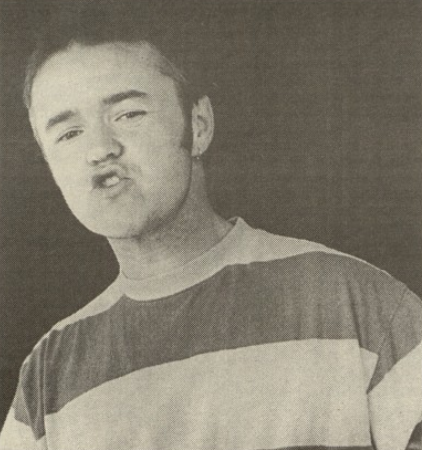
Harrison, who identified as a lesbian before the change, now defines himself as a gay man. It's an added hurdle for mainstream audiences, Harrison says, "It puts it out there that a transsexual man can love men. And that's good for mainstream audiences because it totally confuses them. Teaching people that gender and orientation are different challenges the concept that heterosexuality is the norm. My presence disrupts something very fundamental."
Apparently that disruption hasn't been unwelcome, because FTM has been playing to packed houses in both Canada and the U.S. In fact, Harrison just returned from a run in Vancouver, during which half the dates sold out; he also appeared on Canadian TV, radio, and the six o'clock news. But after months of mainstream performances, Harrison is pleased to be back in his hometown. "Queer audiences get the jokes. Sometimes mainstreamers are afraid to laugh — they're afraid it'll offend me. Queer audiences understand that it's OK."
If you saw the play in '94, you'll note that much has changed. "The words are the same," Harrison says, "but in the performance I'm always looking for new things, things that play better physically. It'll seem quite different from the first run."
Harrison has been concentrating on the physical lately, training with a theater movement specialist in the East Bay. "I may do some Shakespeare," he says enthusiastically. Meanwhile he's working on a new play, one less autobiographical and more concerned with outer relationships than inner journeys.
"FTM is really about becoming oneself, whoever that may be. It may mean letting go of a job or a lifestyle that's unfulfilling. That seems very different from a gender change, but it can have that much magnitude. FTM can be a metaphor for anyone who wants to break out of a restricting lifestyle and really free themselves."
David Harrison's FTM, directed by Mimi McGurl, runs Nov. 1 through Nov. 24, Thursdays through Satursdays at 8:30 p.m., Sundays, 7:30 p.m., in the studio at Theater Rhinoceros, 2926 16th Street. Call (415) 861-5079 for tickets and information.
Bay Area Reporter © 1996
